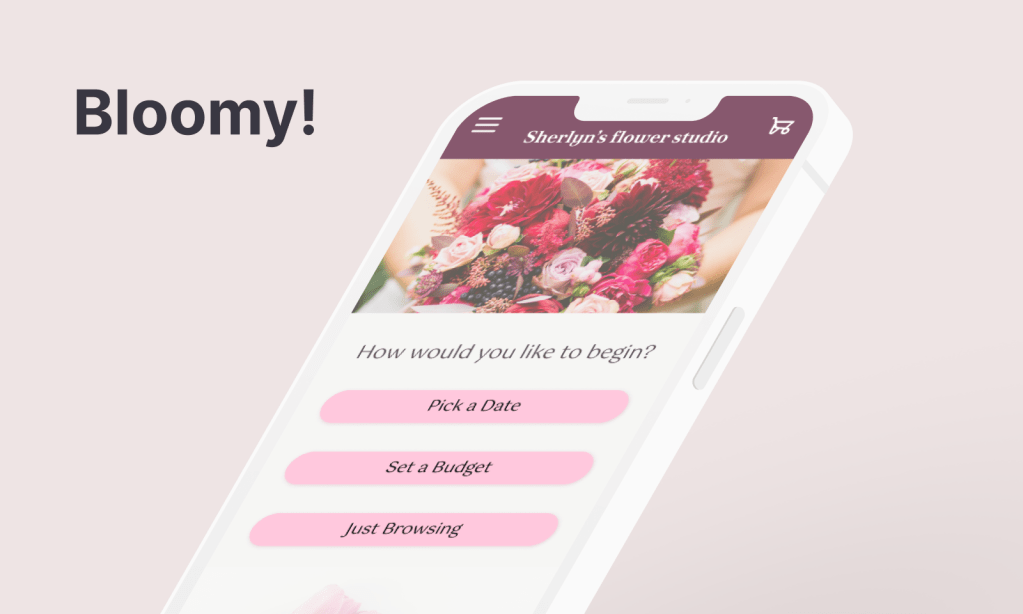
Find nearby florists within your price and time range.
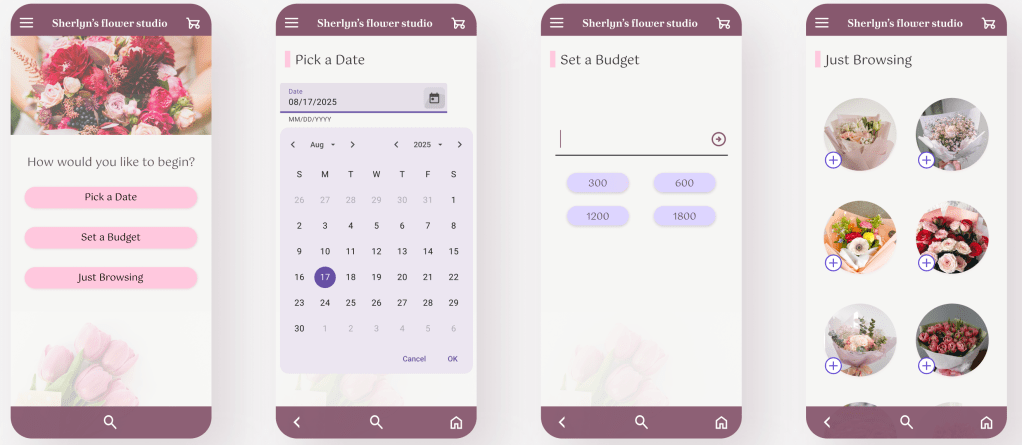
Bloomy! is a mobile app concept that helps users quickly find bouquet options that match their budget and schedule.
This’s an UX course project, which came from my real observations and my own experience buying flowers.
Project Overview

Bloomy!
An app concept that helps busy people order bouquets based on their budget and time.

Duration
Around 4 weeks
Problems
From the client side: Customers lack knowledge about pricing, timing, and florist availability.
From the florist side: Shops struggle with unrealistic budgets, costly back-and-forth communication and holiday capacity.
Goals
Quickly match customers with realistic bouquet options while reducing miscommunication and cancellations.
My Role
Solo Product Designer responsible for end-to-end design.
Responsibilities
Defined the problem space and project scope
Conducted preliminary research and user interviews
Developed user flows and information architecture
Designed wireframes and final UI in Figma
User Research: Summary
Interviews and a survey showed that infrequent and first-time buyers were overwhelmed by too many early choices. Instead of deep customisation upfront, they preferred a guided, low-effort starting point.
I therefore simplified the entry experience into three intents: ‘delivery date’, ‘budget’, or ‘browse’, to reduce decision friction and help users progress faster.
Paint points



Most clients have no idea what a reasonable price for a bouquet is.
They don’t know
which nearby shops are available.
They are not sure how early they should reserve, especially before holidays.
Persona
Problem statement:
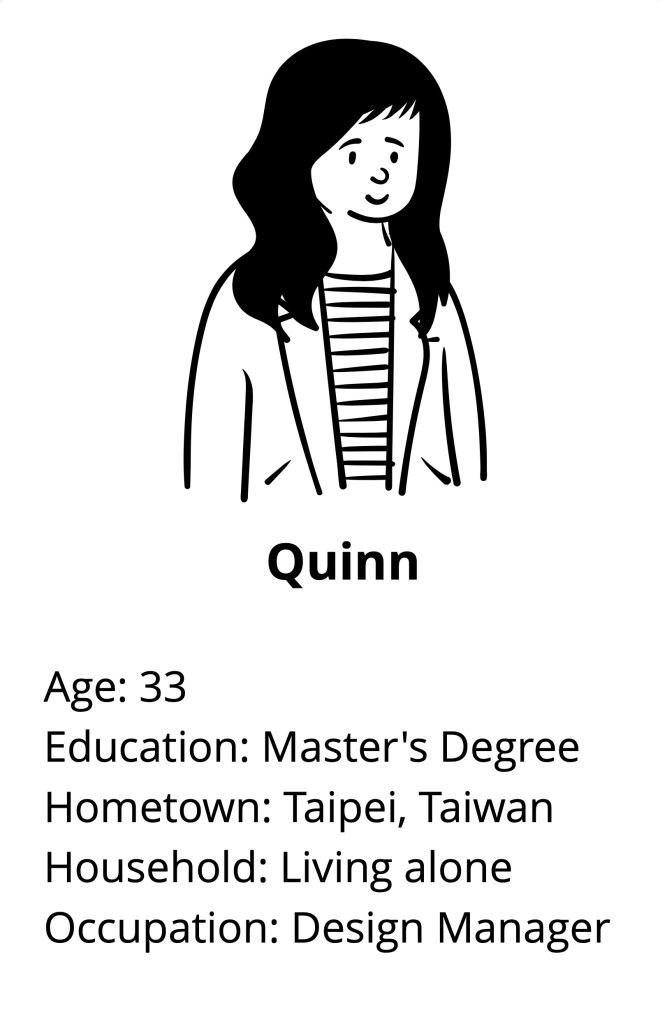
Quinn is a very busy professional.
Her partner’s birthday is just around the corner, but she lacks the time to select the ideal bouquet or shop around to compare prices. Furthermore, she isn’t aware of any local florists (near her home or workplace) that meet her specific requirements and offer convenient collection or delivery times that fit her hectic schedule.
Goals:
- Save time to focus on work and personal life.
- Prefer to pick up flowers directly from a nearby shop instead of waiting for delivery.
- Find bouquets at a reasonable price.
- Ensure the flowers are ready on time for pick-up.
Frustrations:
- No time to search through multiple florists, compare prices, and check their availability.
- Unsure which nearby florists offer pick-up options and can meet their needs.
- Worried the final product won’t match their expectations or budget.
User Journey Map
Persona: Quinn, a busy professional with limited time. Prefers in-store collection to avoid waiting for delivery.
Goals: Find a ideal route that will take him to the Empire State Building
| Action | Browse Shops | Choose Bouquet | Pick a Date | Select Time Slot | Confirm & Pay |
| Task list | Opens app, filters by budget, checks shop page | Reviews price, size and style | Taps “Select Collection Time” | Picks a slot that fits schedule | Reviews order and pays |
| Feeling adjective | Wants quick, suitable options | Hopes to decide quickly | Wants immediate clarity | Needs certainty it’ll be ready | Wants a smooth finish |
| Important Opportunities | Highlight “Earliest Collection Time” and “Click & Collect” | Clearer product info and preparation time | Show available/unavailable slots upfront | Display estimated preparation time and recommended slots | Provide a concise, reassuring summary |
Digital Wireframes
1. First Low-fidelity Prototype
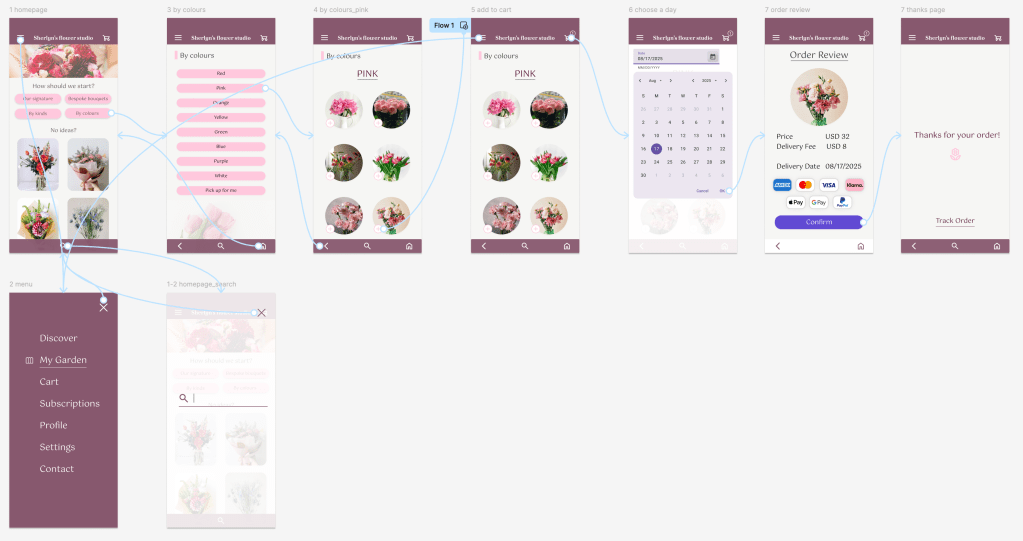
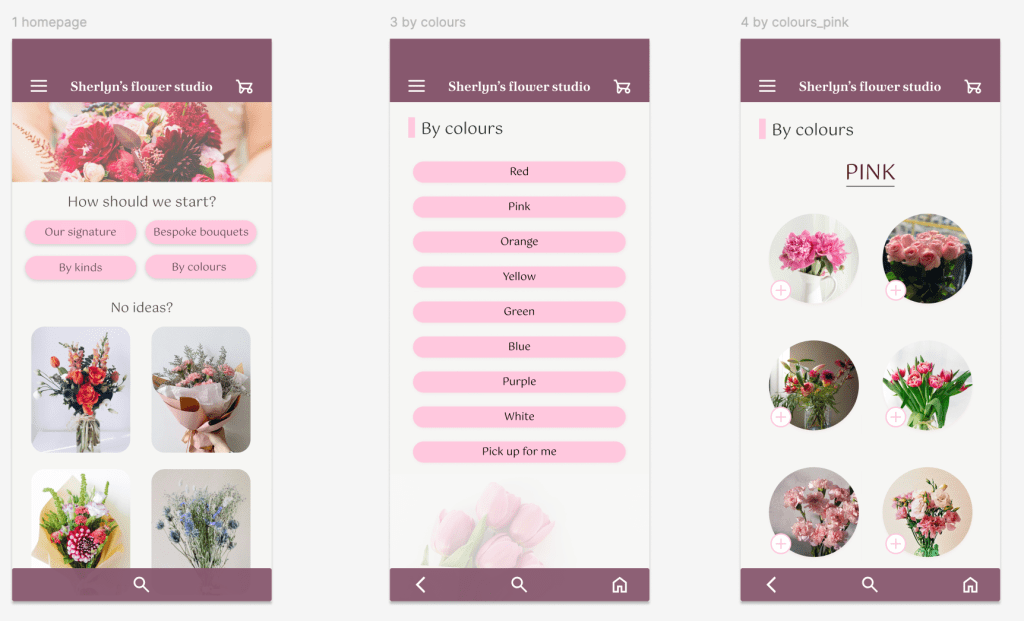
- The homepage included options such as ‘By Colours’, ‘By Types’, ‘Bespoke Bouquet’, and ‘Our signature’.
- The early design focused on offering various choices, but it didn’t create any real value. It looked like a typical flower-ordering app and didn’t address any specific problem.

2. Turning Point
By observing social media (both florists and customers) and talking to my floral class teacher (who also runs a flower shop), I realised that more features do not necessarily solve users’ problems.
Interviews revealed the real pain points:
- Users don’t know the current price of flowers
- They don’t know which shop to start with, they can only rely on recommendations from friends
- They’re unsure how far in advance
They would like to know if they can pick up flowers today, and how long it takes to prepare a bouquet.
3. Second Version High-fidelity Prototype
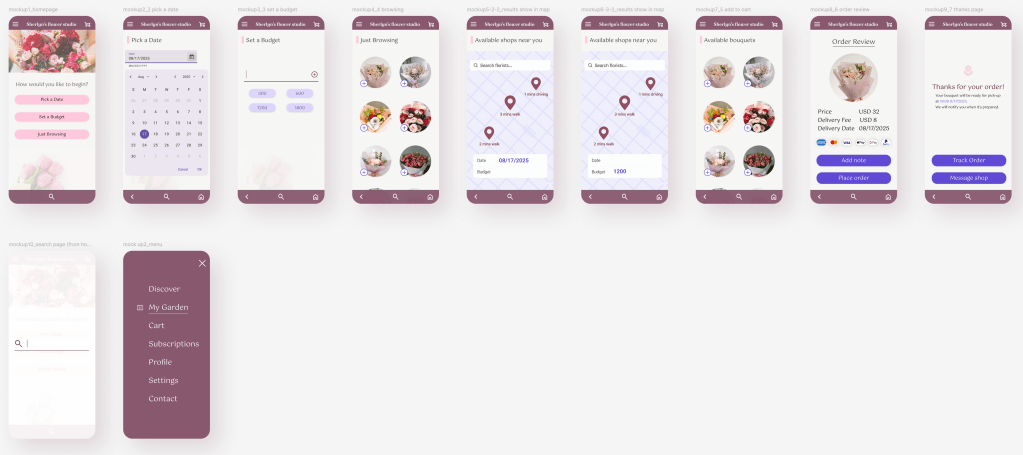
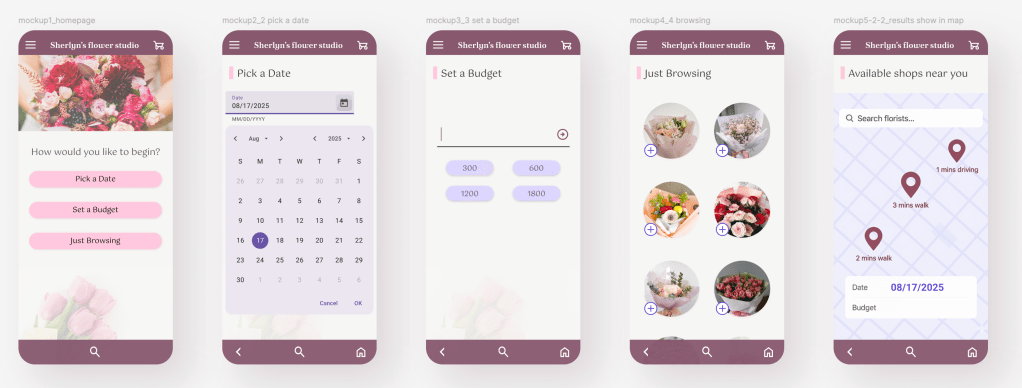
- Choose time, budget, and browse randomly. The design also displays available flower shops (start from 5km radius)
- Each feature addresses a specific problem:
Choose time solves the needs of customers with last-minute orders or those who suddenly want a bouquet
Choose budget: bridges the information gap between customers and florists
Browse randomly: helps potential customers who want to buy flowers but don’t know where to start
Usability study: parameters
- Study type: Unmoderated usability study
- Location: Taiwan, remote
- Participants: 4
- Lengths: 10 minutes
Going forward
At this stage, Bloomy! is a mid- to high-fidelity prototype created for a UX course. I have not yet run formal usability testing, but the process already gave me several important learnings.
Learnings & Findings
- Interviews highlighted that not everyone wants a fully automated process. Some people still appreciate 1:1 conversations with florists. The design should therefore support both quick ordering and more personalised interaction.
- The app is not simply about finding “cheap” flowers. It is about setting realistic expectations for both sides and helping people understand what is feasible within their budget and timeframe.
- Even with a small sample, early research can reveal surprising patterns. For example, how budgets relate to the emotional significance of the occasion, rather than income level alone.
- TWD 500 seems to be an acceptable starting price point: regardless of budget range, most potential customers were comfortable with this amount.
Next steps
If I had more time and resources, I would like to:
- Run usability tests with both customers and florists to validate the overall flow and interaction patterns.
- Expand the florist-facing features: enabling shops to upload signature bouquets, manage their calendars, and define how far in advance customers can book (for example, up to three months).
- Explore ways to better support special requests, such as table arrangements for events, not only bouquets.
Thanks for reading.
Hope you enjoyed the journey.

 Sherlyn Lin